Skip to Content

OBJECTIVE 92 DB

At Club Victory, the reference for noise emissions is the noise produced by modern enduro motorcycles equipped with the original silencer in good condition. In such a configuration, they comply with the current noise emission standards for vehicles allowed to circulate on public roads. Depending on the motorcycle you own, please refer to one of the scenarios below (we are always talking about modern motorcycles).

4-stroke enduro motorcycle


If it is equipped with the original exhaust system in good condition, no worries, you are within the Club's standards. Make sure to regularly replace the glass wool in the silencer.

If it is equipped with a silencer not original, ensure that it does not make more noise than the original one (this is very rarely the case...)

In any case, if you have doubts or want to be sure you are okay, feel free to approach the technical service for their opinion.* 

2-stroke enduro motorcycle


If it is equipped with the complete original exhaust system (expansion chamber + silencer), in good condition, no worries, you are within the club's standards.

However, make sure to regularly replace the glass wool in the silencer. If it is equipped with a system not original, ensure that it does not make more noise than the original one (this is very rarely the case...)

Si le pot de détente d'origine a été remplacé par un autre, non d'origine, there is a strong chance (it is not systematic) that it is too noisy. Indeed, very often, the original exhausts of enduro motorcycles have double walls, which is not the case with non-original exhausts. It should be noted that on a 2-stroke, a large part of the noise emissions comes from the exhaust. Solution: see below.

In any case, if you have doubts or want to be sure you are okay, spontaneously present yourself to the technical service to get their opinion.*

* Some motorcycles are close to the limit when stationary and can turn out to be too noisy when in motion. This may depend on the riding style. In this case, you may be asked to go through the technical staff, but you will be covered by the fact that you have shown your good will by presenting yourself spontaneously.

4-stroke motocross bike


Equipped with the original exhaust system, it is excessively noisy. Moreover, it is often replaced by a much noisier non-original one.

In any case, with this type of motorcycle, you are not within the Club's standards. If you go on the track with this motorcycle equipped with its original exhaust or any other cross exhaust, you exclude yourself from the Club.

Solution: see below.
2-stroke motocross bike


Equipped with the original exhaust system or not, it is also too noisy but to a lesser extent than the 4-strokes.In any case, with this type of motorcycle, you are not within the Club's standards. If you go on the track with this motorcycle equipped with its original exhaust or any other cross exhaust, you exclude yourself from the Club.

Solution: see below.


The solutions

If you are not within the Club's standards, here are the solutions:

4 STROKE


Enduro bikes: restore the original exhaust system and ensure that the glass wool in the silencer is in good condition.

Cross bikes: call upon the services of the Club and reserve a " Victory tip " or acquire an enduro silencer. In this case, beware of silencers that only have the name enduro. Indeed, some companies market cross silencers under the name "Enduro" equipped with a disc that reduces the final outlet diameter (decibel killer). Not only is the result in terms of noise reduction insufficient, but these silencers quickly become as noisy as a cross bike, as the overly restricted gases burn the wool.

Some manufacturers refer to FIM standards regarding noise emissions. These have evolved significantly in recent years, so check which year they refer to when presenting a product as "Compliant with FIM standards "

2 STROKE


Enduro bikes: restore the complete original exhaust system and ensure that the glass wool in the silencer is in good condition. If the bike is old, proceed as for cross bikes.

Cross bikes: wrap the expansion chamber in soundproofing material.


Solution 1

Aesthetic and durable, it involves wrapping a ceramic fibre tape around the expansion chamber on both sides at its widest part, over +/- 40 cm. You can then cover everything with glass fibre impregnated with polyester. Smooth and paint for an optimum finish (see photos).

Solution 2

Quick, inexpensive and very effective, it involves wrapping a bicycle inner tube around the widest part of the silencer over +/- 40 cm. Hose clamps or neatly twisted wire placed at both ends hold it in place (see photo). Do not place the inner tube less than 20 cm from the cylinder outlet. Placed under these conditions, the inner tube does not melt.

In both cases, if the glass wool of the silencer is in good condition, this solution may suffice. Otherwise, the Club can lend a special 2-stroke Victory tip that will eliminate the last excess decibels.

Installation

Remove the silencer and start wrapping from the back of the silencer to the front. Ensure that the strips partially overlap with each turn. Stop +/- 20 cm from the cylinder outlet.

Tip: while the silencer is removed, check for any play between the silencer and the cylinder outlet. If so, replace the O-rings or wrap plumbing-type Teflon to compensate for the play.

Victory tip


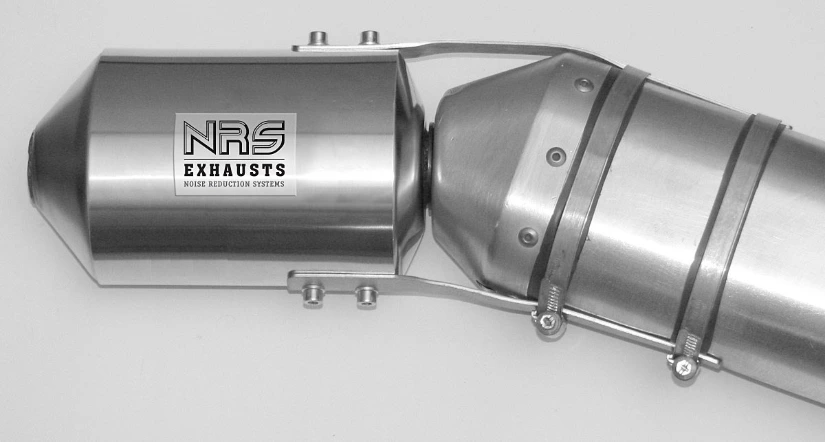
Universal tip developed by the Club that fits the outlet of cross "silencers". An adapter ring compensates for diameter differences. It can be fitted in a few minutes on all motorcycles with a straight silencer outlet. We lend them free of charge to members who request them. To reserve via the online form (click here) by Friday evening at the latest, specifying the make, model and engine size of the motorcycle as well as the type of silencer (original or otherwise the brand of the one that replaces it) and the diameter pot exit. For the installation, which is done graciously by the Club's technical team, please arrive at 9:00.

The Victory tip is also marketed under the name NRS-Exhausts via the site www.nrs-exhausts.com


Silence and performance


There is a strongly entrenched misconception in motorsports that the freer an exhaust is, the more powerful the engine is. As soon as we talk about effective silencers, voices are raised to say that with this type of exhaust, the bike no longer "pulls". Nothing could be further from the truth, provided that the silencer is specially designed to be effective. As we explain below, each of our pot configurations has been tested on the dynamometer. As a side note, and to put an end to the beliefs, it should be noted that a Honda 250 CRF equipped with the Victory tip gains 1 hp!See curves


Noise emission file (written in December 2004)


It is no longer a secret to anyone, the deafening noise emitted by modern 4-stroke motocross bikes is a real calamity for the practice of our sport. Between the standards imposed on motocross bikes by the FIM and the reality, that is to say the perception of noise in the immediate environment of the track, there is a gap that local residents and some practitioners can no longer accept.

How is it possible to market such noisy bikes? Explanations below. 

Why so much noise?


For your information, we communicate below the noise control conditions as defined by the FIM. The measuring device must be placed 50 cm from the exhaust at an angle of 45°. For motocross bikes, the sound emissions must not exceed 98 db. The FIM recommends taking measurements at the following engine speeds: 7,000 RPM for a 125 cc, 5,000 RPM for a 250 cc, and 4,500 RPM for a + 250 cc. In reality, it should be based on a linear piston speed of 13 m / sec. Knowing that the stroke of a 450 CRF is 62.1 mm, the measurements should be taken at 6280 RPM, which is nearly 2000 RPM higher. At the time these conditions were established, a BSA 500 motocross bike with a stroke of around 90 mm peaked at +/- 5,000 RPM, which means that the measurements were taken with an engine close to its maximum speed. The 13 m / s was reached at 4333 RPM. It is therefore noted that today the measurements are recorded below mid-rev ranges. So if the 98 db is reached at mid-rev, imagine the result at full throttle and under load. Emissions of up to 110 db have been recorded at some Grand Prix events. The first to benefit from this mismatch of standards to modern bikes are the manufacturers who can freely market machines louder than ever. The problem is that consumers are increasingly struggling to find places to use them.

Target 92 DB


In early 2004, we launched our Objective 92 Db campaign with incentive measures that were not mandatory. We gave ourselves the entire season to thoroughly study the situation and evaluate market solutions. The first observation: all enduro motorcycles, 2-stroke or 4-stroke, equipped with the original silencer in good condition met our requirements, which allowed us to establish a benchmark for the result to be achieved with motocross bikes. We then studied the market in search of effective silencers. Indeed, in their catalogues, manufacturers of exhausts offer models referred to as enduro 92 Db. Unfortunately, we quickly realised that many products bearing the Enduro FIM label did not meet the objectives we had set. Others, effective in the first hours of use, quickly emitted the same noise level as a motocross exhaust. On several occasions, we raised the issue with certain manufacturers but without tangible results. At present, the only enduro exhaust on the parallel market that meets the standards of the Club Victory is the CRD Enduro 92 db, which is, moreover, the only non-original exhaust to pass the sound meter test without issues in the French enduro championship.

History of the Victory end


In light of the lack of motivation from market players, we do not blame them; apart from us, there is no demand for silent exhausts, we decided to tackle the problem head-on. Objective: to find a truly effective solution ourselves in terms of both noise and performance, adaptable to most original exhausts of motocross bikes, with 4-strokes in mind. Aware that the price of a FIM exhaust (between €300 and €400) is prohibitive for many practitioners, we directed our research towards low-cost solutions. Very quickly, the idea of an attachment that could be fitted onto the original exhaust emerged. During the winter of 2004/2005, every Sunday, the Verleysen brothers, Reginald Ceûppens, and I tested and improved various configurations of exhaust tips. The final result exceeded our expectations. Equipped with the "Victory" tip that adapts to their original "silencer", the 4-stroke motocross bikes now emit a noise level equivalent to that of 4-stroke enduros fitted with the original silencer! The 2005 season was used to test our tip in "live" conditions. It proved to be reliable and universal.

Tuning of the "Victory" silencer


For those interested, here is the technical aspect of the development of our silencer.

With the help of a special program developed in Excel and based on the work of an Irish engineer, Gordon Blair, different configurations of baffle chambers are studied, the software providing the attenuations in dB according to the frequencies. When the best theoretical result is obtained, the silencer is designed using an industrial drawing program. Once the prototype is made, testing must commence. First test, assessment of the sound attenuation deemed sufficient or not. Second test: bench testing and comparison of the power curve with that of the motorcycle in its original configuration (difference in torque and power). In developing these silencers, the aim has always been to alter the original curves as little as possible. For this, the gases must evacuate smoothly. The geometry of the silencer must take this into account. If the torque and power test is satisfactory, we move on to the 3rd test, that of barometer. This is a water level connected to the exhaust system that allows for the measurement of pressure losses due to the outlet. Ideally, the overpressure should remain below 100 mb which means that the gases evacuate smoothly. A good silencer will therefore have good attenuation while allowing for good gas evacuation, ensuring performance that is little or not altered. It should be noted that it is easy to reduce the noise of an exhaust by decreasing its section at the outlet, but the health of the engine is immediately affected. Achieving the final result that we tested live has been a laborious task. There are countless projects that have stumbled on one test or another because an additional parameter came into play; the silencer had to be not too complicated and therefore not too costly to produce. Alain Spira

Special thanks  for his valuable advice to Lucas Vandamme, automotive engineering expert and member of our Club.